Timeboxes: Driving Value Beyond the Clock


Sagar Zilpe

Principal Transformation Consultant | Interim CTO | AI & PMO Advisor (Gen AI/ Enterprise

Timeboxes: Driving Value Beyond the Clock

In Agile, Timeboxing is more than just limiting time—it's about maximizing value within the set time. Whether it’s a 15-minute daily stand-up, a 2-hour sprint planning session, or a 90-minute retrospective, the aim is not just to end on time but to drive focused, outcome-oriented discussions.

However, in practice, teams often face these challenges:

  • Should we stick to the timer even if critical ideas are emerging?
  • How do we avoid rushing through meaningful conversations?
  • How do we onboard new teams or stakeholders without pressuring them?

The real success lies in deriving maximum collaborative value, while developing time discipline gradually.


The Right Value Comes Before the Right Clock

On day one of a project—or while working with a new team, client, or service provider—expecting a perfect 15-minute stand-up is unrealistic.

Why?

  • The team is still learning the product, context, and each other’s style of working.
  • Organizational priorities and OKRs may not be fully clear.
  • Members may be unsure what’s truly valuable to share in a limited timeframe.

This is where “value-first” Timeboxing matters. Instead of forcing the timer:

  • Encourage open conversations about blockers, goals, and dependencies.
  • Aim first for clarity and alignment before focusing on time.
First Milestones of Value-First Timeboxing:

  • Reduced repetition with clear, focused updates.
  • Shift from historical reporting to future blockers and enablers.
  • Stronger connection to OKRs and sprint goals for each member.

When teams prioritize value, time discipline naturally follows.


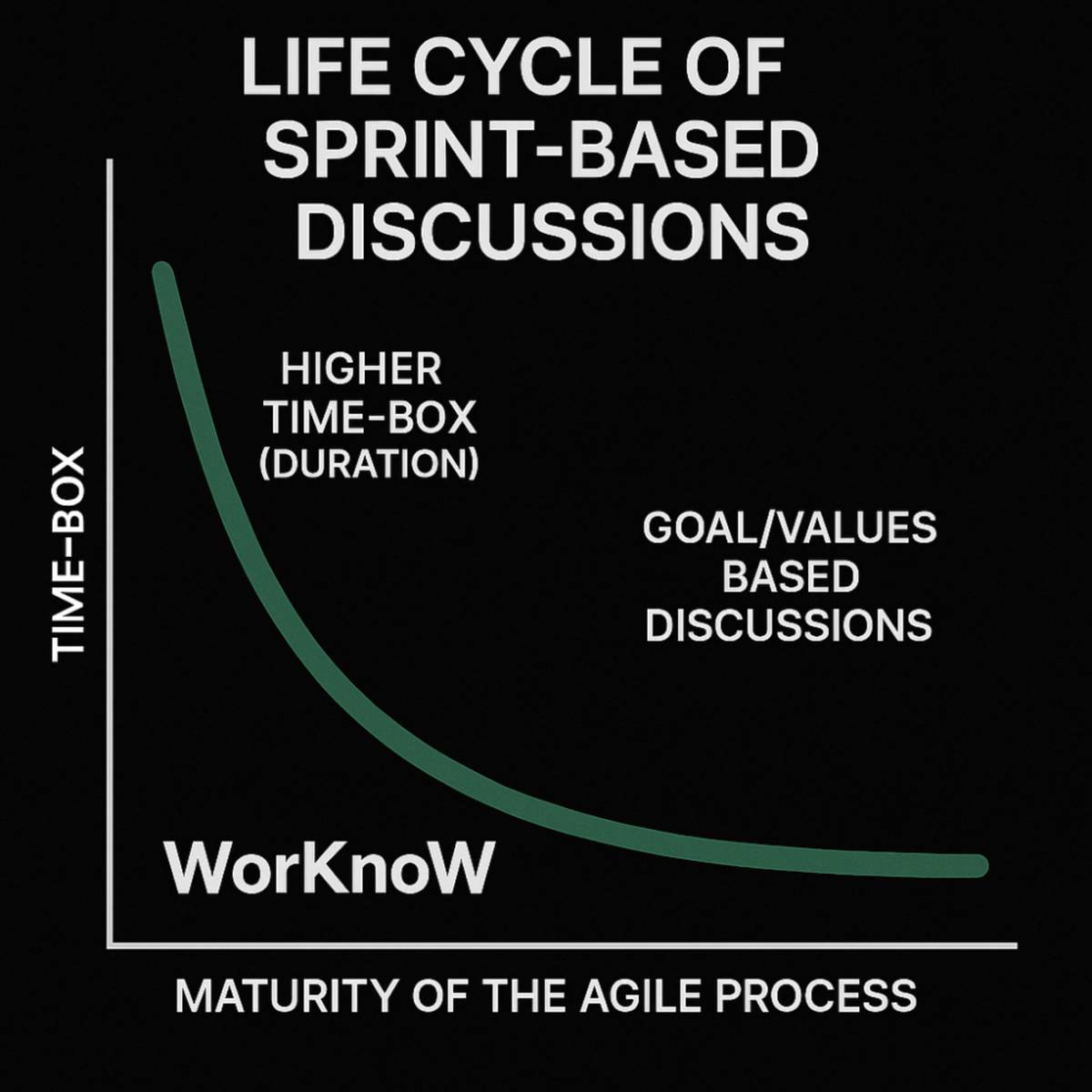
WorKnoW® Timebox duration and agile maturity model  

Time Discipline is a Journey, Not a Target

Think of a Timebox as a runway, not a stopwatch. The goal is to help the team take off, not stop mid-run because the clock expired.

In the first few days (Day 1–Day 5) of a sprint, the team might take 20–25 minutes for stand-ups. That’s fine—as long as every minute adds value. Gradually, through facilitation (by the Scrum Master, Project Manager, or even peer leads), the team learns to deliver the same value in 15 minutes.

Here's one of the practice reference

  • A new Agile team I worked with initially took 27 minutes for stand-ups. After introducing a simple structure—What was achieved yesterday? What is planned for today? What are the blockers? —we brought it down to 17 minutes within 2 sprints.
  • After 4 sprints, the stand-up was just 11 minutes, but value delivery increased because discussions shifted from status updates to forward-looking decisions and blockers.

    Onboarding Teams into Timeboxes

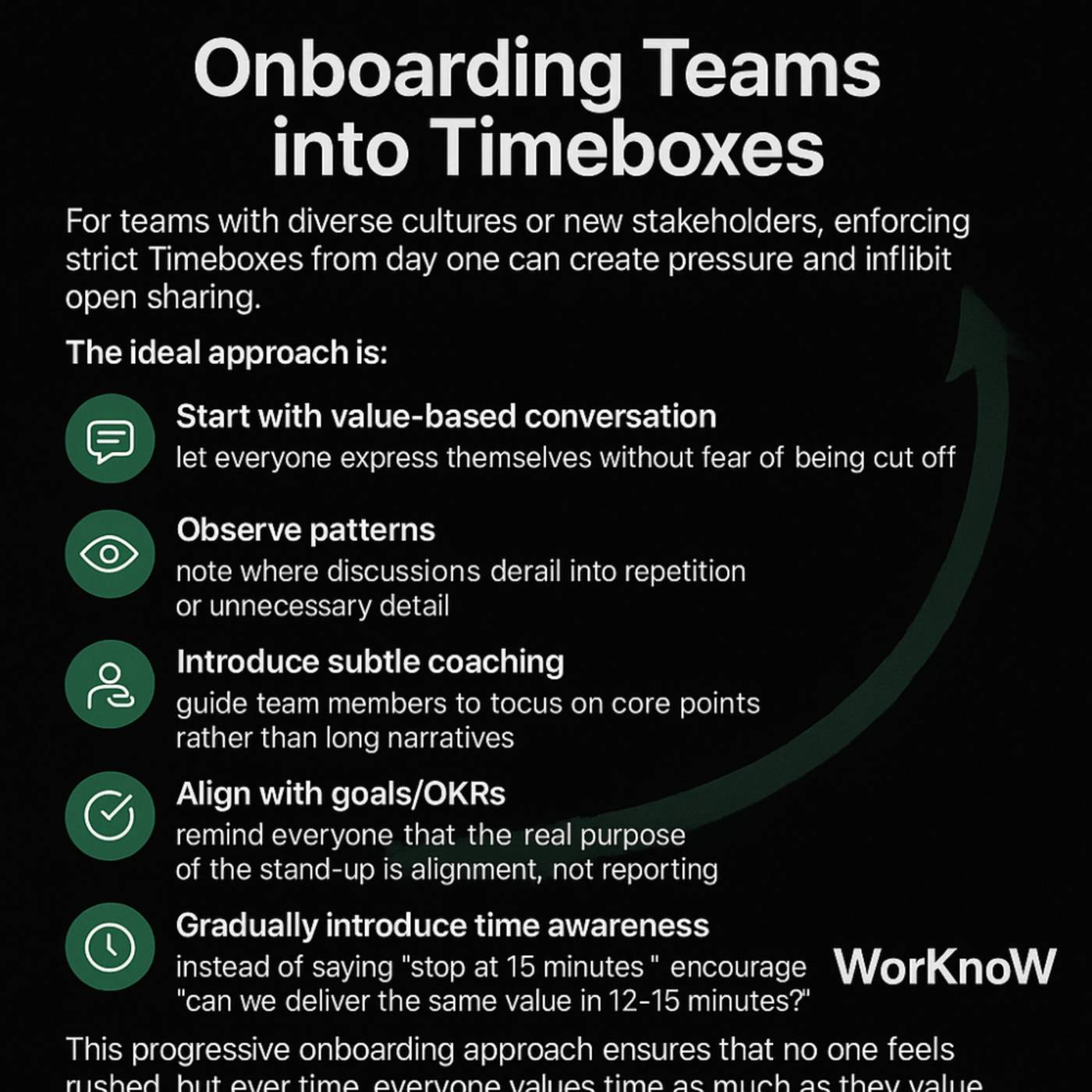
With diverse cultures or new stakeholders, strict time enforcement can feel rushed and counterproductive..

Progressive Onboarding Approach:

  1. Start with value-based conversations – let everyone express themselves without fear of being cut off.
  2. Observe patterns – note where discussions derail into repetition or unnecessary detail.
  3. Introduce subtle coaching – guide team members to focus on core points rather than long narratives.
  4. Align with goals/OKRs – remind everyone that the real purpose of the stand-up is alignment, not reporting.
  5. Gradually introduce time awareness – instead of saying “stop at 15 minutes,” encourage “can we deliver the same value in 12–15 minutes?”

This progressive onboarding approach ensures that no one feels rushed, but over time, everyone values time as much as they value collaboration.


   WorKnoW® Onboarding Teams into Timeboxes


When Value Overrides the Clock

Exceeding a Timebox isn’t always failure—it may show team openness and trust..

  • If a team member needs 3 extra minutes to raise a critical blocker that could save 2 days of rework, isn’t that worth it?
  • If a product owner or developer has an idea that can shape a sprint goal, should we stop them for the sake of 15 minutes?

The ideal culture is where the team self-regulates:

  • Everyone is mindful of keeping updates concise (1-2 minutes each) but
  • Critical enablers or blockers are not sacrificed for the sake of a timer.

This balance between human factors and time discipline is what creates high-performing Agile teams.


The Maturity Curve of Timeboxing

In my experience across 3,000+ teams and projects, I’ve seen that:

  • 20% of mature teams consistently meet the 15-minute Timebox while delivering high-value discussions because they’re aligned on goals with process maturity.
  • 80% of teams initially miss Timeboxes not due to inefficiency, but because they value open opinions, clarifications, and shared understanding.

The solution isn’t to force them into the clock but to help them mature by:

  • Focusing on decision-making and collaboration rather than just updates.
  • Encouraging ownership of the stand-up by every team member, not just the Scrum Master.
  • Iteratively reducing the stand-up time as the team learns to focus on what matters most.

The Ideal State: Value + Time Efficiency

The end goal is for teams to:

  • Consistently derive value (clarity, decisions, blockers, innovation) in every Timebox.
  • Use time as an enabler, not a constraint.
  • Ensure that no conversation feels incomplete or rushed while still finishing on time.
  • Mirror this discipline across all ceremonies—from daily stand-ups to sprint reviews and retrospectives.

When a team achieves this, Timeboxes stop being just meetings—they become catalysts of alignment, speed, and innovation.


Practice based experience

A team I mentored recently was taking 25 minutes per stand-up because every developer narrated technical details. We made a simple shift:

  • Developers highlighted only blockers or dependencies in the stand-up.
  • Detailed discussions were moved to post-stand-up breakout sessions.

The result?

  • Stand-ups went down to 14 minutes on average,
  • Sprint goal achievement improved by 15%, and
  • The team felt more engaged because no one was rushing them during the stand-up.

           Guidance for practitioners

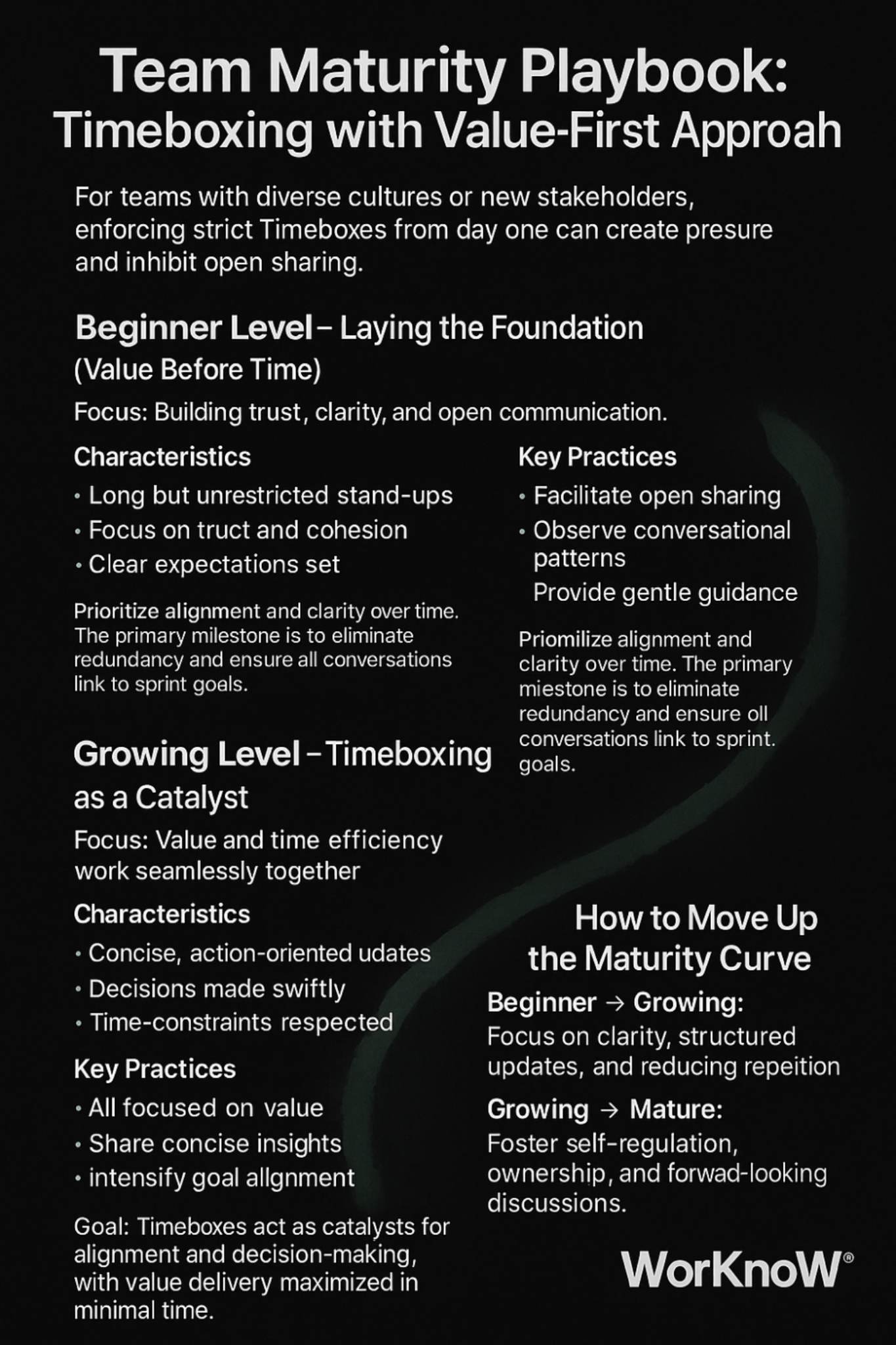
Here's a short “Team Maturity Playbook” that outlines 3 levels (Beginner, Growing, Mature) for evolving Timeboxing practices while keeping value as the central focus:


           WorKnoW® Team maturity playbook   


Team Maturity Playbook: Timeboxing with Value-First Approach


1. Beginner Level – Laying the Foundation (Value Before Time)

Focus: Building trust, clarity, and open communication.

  • Characteristics: Stand-ups and ceremonies exceed the ideal time (20–30 minutes). Team members share long, detailed updates (status-oriented). Lack of clarity on what’s "valuable" to share during ceremonies. Discussions often derail into technical deep-dives or unrelated topics.
  • Key Practices: Encourage open sharing – Allow team members to voice blockers, dependencies, or ideas without time pressure. Facilitator role is strong – Scrum Master or PM steers conversations back to sprint goals and OKRs. Value definition – Agree on what constitutes a "valuable update" (blockers, progress, dependencies). After-stand-up breakouts – Move deep technical conversations outside of the main Timebox.
  • Goal: Prioritize alignment and clarity over time. The primary milestone is to eliminate redundancy and ensure all conversations link to sprint goals.

2. Growing Level – Balancing Value & Time

Focus: Streamlining updates without losing value.

  • Characteristics: Stand-ups are 15–20 minutes, but value-driven conversations are emerging. Team members begin to self-regulate updates. The facilitator occasionally nudges the team to be concise. Discussions start aligning with future blockers and enablers, not just past activities.
  • Key Practices: Structure the Timebox – Use the “Yesterday, Today, Blockers” format for updates. Introduce time-awareness – Use soft reminders like “Let’s aim for 2 minutes each.” Link updates to sprint goals – Every conversation should connect back to progress toward the sprint outcome. Encourage cross-team collaboration – Shift discussions from reporting to problem-solving.
  • Goal: Achieve value and time balance – every stand-up or ceremony consistently drives decisions, with time-awareness introduced but not forced.

3. Mature Level – Timeboxing as a Catalyst

Focus: Value and time efficiency work seamlessly together.

  • Characteristics: Stand-ups average 10–15 minutes with high alignment and clarity. The team self-manages discussions—no facilitator is required to enforce the Timebox. Conversations are forward-looking and solution-focused rather than status-based. Deep discussions are immediately shifted to breakout sessions.
  • Key Practices: Strict but natural Timeboxing – Teams end ceremonies on time without feeling rushed. Continuous improvement mindset – Retrospectives identify not just process gaps but also time-value imbalances. Data-driven insights – Use metrics (e.g., number of blockers resolved post-stand-up) to measure value. Value-first culture – Teams prioritize alignment and impact over simply "fitting into the 15-minute window."
  • Goal: Timeboxes act as catalysts for alignment and decision-making, with value delivery maximized in minimal time.

How to Move Up the Maturity Curve

  • Beginner → Growing: Focus on clarity, structured updates, and reducing repetition.
  • Growing → Mature: Foster self-regulation, ownership, and forward-looking discussions.

Key Takeaway

Timeboxes are not about being strict with the clock—they’re about making every minute count. A team that first focuses on value and then gradually adopts time discipline will not only meet Timeboxes but will derive greater collaboration and outcomes.