Introducing “Ways of Working as a Service (WoWaaS)” – A New Frontier in Organizational Delivery


Sagar Zilpe

Principal Transformation Consultant | Interim CTO | AI & PMO Advisor (Gen AI/ Enterprise

Introducing “Ways of Working as a Service (WoWaaS)” – A New Frontier in Organizational Delivery

Introduction: Context Behind the Concept

Sometimes, the most powerful ideas emerge not in boardrooms, but in classrooms. During a recent Project Management Professional (PMP) coaching session, I was mentoring a cohort of senior professionals, many carrying over two decades of industry experience across sectors. The discussion on “Ways of Working” triggered a striking question:

If software can be delivered as a service, and platforms can be delivered as a service — why can’t ways of working be delivered as a service?

This was not an abstract curiosity. It arose directly from lived challenges across industries — from software and banking to oil & Gas and construction. Giants in these industries are struggling with the same recurring issue:

how to adapt methodologies and delivery approaches to diverse, complex, and rapidly changing environments.

If software can be delivered as a service, and platforms can be delivered as a service — why can’t Ways of Working be delivered as a service?

This is not a passing curiosity. It is an urgent necessity.

The world around us is being reshaped every day — by disruptive technologies, volatile market landscapes, shifting supply chains, climate pressures, political upheavals, wars, and new models of operation. Industries everywhere are feeling the tremors. From banking to construction, from oil & Gas to software, leaders are wrestling with the same recurring problem: how do we adapt our methodologies and delivery approaches to contexts that refuse to stay still?

                Problem Statement being solved by WoWaaS


We have already seen the journey:

  • From Waterfall to Agile
  • From Agile to Lean-inspired ways of working
  • And now into hybrid, contextual, and continuously evolving models

But here lies the deeper question:

Are we simply following values and practices that worked for others, or are we truly living and shaping values that fit our own unique context?

Too often, organizations adopt cookie-cutter frameworks, copying what worked elsewhere. The result? Misalignment, friction, and fragile delivery models.

What if, instead of “adopting” methods, we began to engineer our own ways of working?

  • Ways designed from the ground up by understanding our people, our business realities, our processes, and the complexity of our products.
  • Ways that are tailored, contextual, and matured to deliver not just efficiency but resilience.

This is how the concept of Ways of Working as a Service (WoWaaS) emerged: not as an abstract theory, but as a transformational framework — one that allows organizations to continuously source, evolve, and operationalize their delivery mindset.

Because in times of disruption, it is not enough to work aligned. 👉 We must think aligned. We must live aligned. We must design alignment.

Out of this dialogue emerged a powerful concept:

Ways of Working as a Service (WoWaaS).

 Human Generated Insightful Framework by PMO. Sagar Zilpe


What is WoWaaS?

At its core, WoWaaS is a structured, consultative, and adaptive service model that helps organizations validate their environment — internal and external — and deliver tailored methodologies for project and product success.

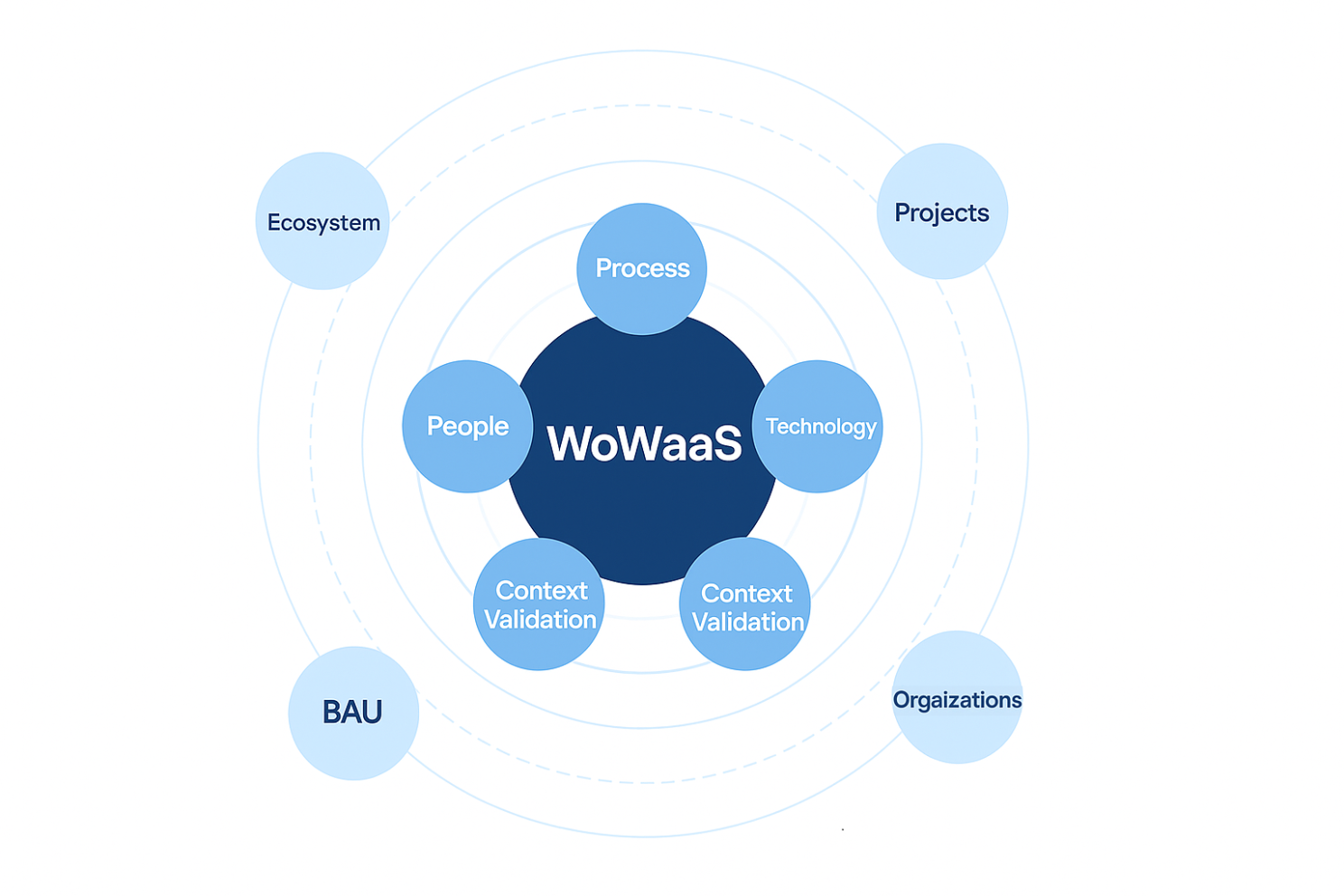
It moves beyond rigid templates or “one-size-fits-all” delivery. Instead, it provides organizations with a service-oriented approach where People, Process, Technology, and Context are dynamically aligned to project objectives, external factors, and organizational culture.


Why WoWaaS Matters Now

Every organization today operates in multiple modes at once:

  • Some projects are fully in-house, owned by PMOs or Value Delivery Offices.
  • Others are partnered with consulting firms for expertise.
  • Many are outsourced to specialist providers or contractors.
  • Increasingly, delivery happens through subsidiary-driven or consortium-based models, often layered with complex contracts, bids, or compliance obligations.
Each of these arrangements brings its own challenges of cost, confidentiality, control, scalability, and context.

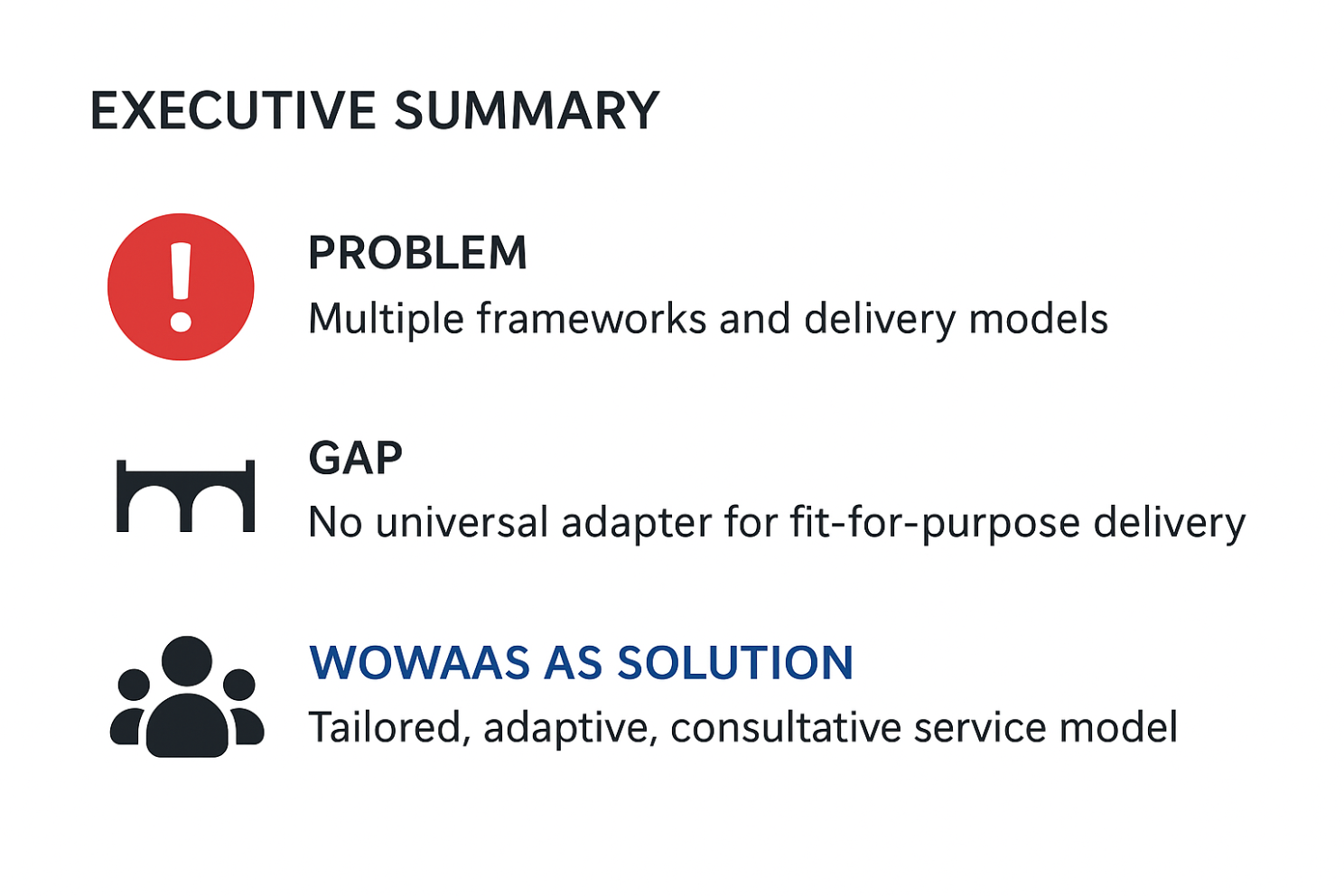
Traditional frameworks (Agile, PRINCE2, SAFe, Lean, etc.) are all powerful in their own right. But here’s the catch: no single framework fits every scenario. Leaders often end up with a patchwork of methods, struggling to “adopt” what others have used — only to discover that what worked elsewhere may not translate in their unique environment.

That is where WoWaaS becomes transformative.


                                   WoWaaS : Gravity View


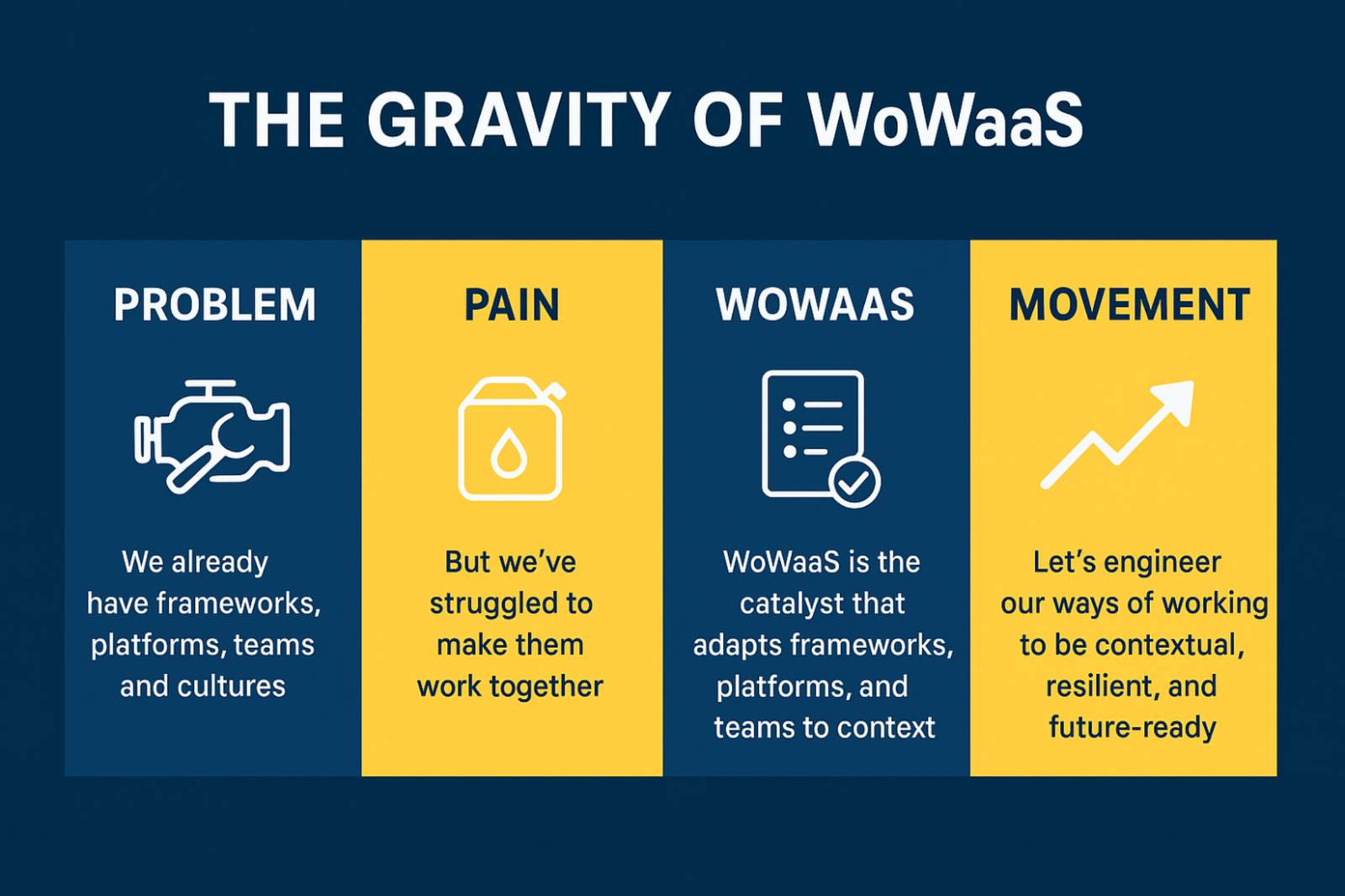
The Gravity of WoWaaS

In today’s organizations, the challenge is not a lack of tools or methods. We already have abundant frameworks, platforms, teams, and cultures.

But here’s the hard truth: having ingredients doesn’t guarantee a meal. Having vehicles doesn’t guarantee reaching your destination. Having engines doesn’t guarantee speed without the right fuel.

What organizations lack is the adaptive catalyst — the GPS, the fuel, the formula — that makes all these moving parts come alive in context.

👉 WoWaaS is that catalyst.

It is the framework that:

  • Validates context (internal and external, stable and disruptive).
  • Tailors methodologies so they fit, instead of force-fitting.
  • Bridges theory and practice by aligning people, processes, technology, and culture.
  • Brings structure, repeatability, and resilience to what has so far been ad hoc and reactive.

Yes, many organizations already experiment with this informally — through consultants, PMOs, Value Delivery Offices, or hybrid playbooks. But experimentation without structure is fragile.

That is why WoWaaS matters now more than ever:

  • In a consortium project.
  • In outsourced delivery.
  • In joint ventures.
  • In hybrid and in-house teams.
  • Across projects with differing outcome, benefit, and product complexities.

WoWaaS provides the missing formula. It is not about blindly adopting another framework. It is about engineering ways of working that are contextual, resilient, and future-ready.

This is not just a new model. 👉 It is a movement. A call to action for organizations to stop copying and start creating. To stop following values, and start living them in their own context. To stop seeking “one-size-fits-all,” and start demanding fit-for-purpose.

Because in the age of disruption, success will not belong to the ones with the most frameworks — it will belong to the ones with the right ways of working, delivered as a service, when and where they need it most.
Core Components of WoWaaS

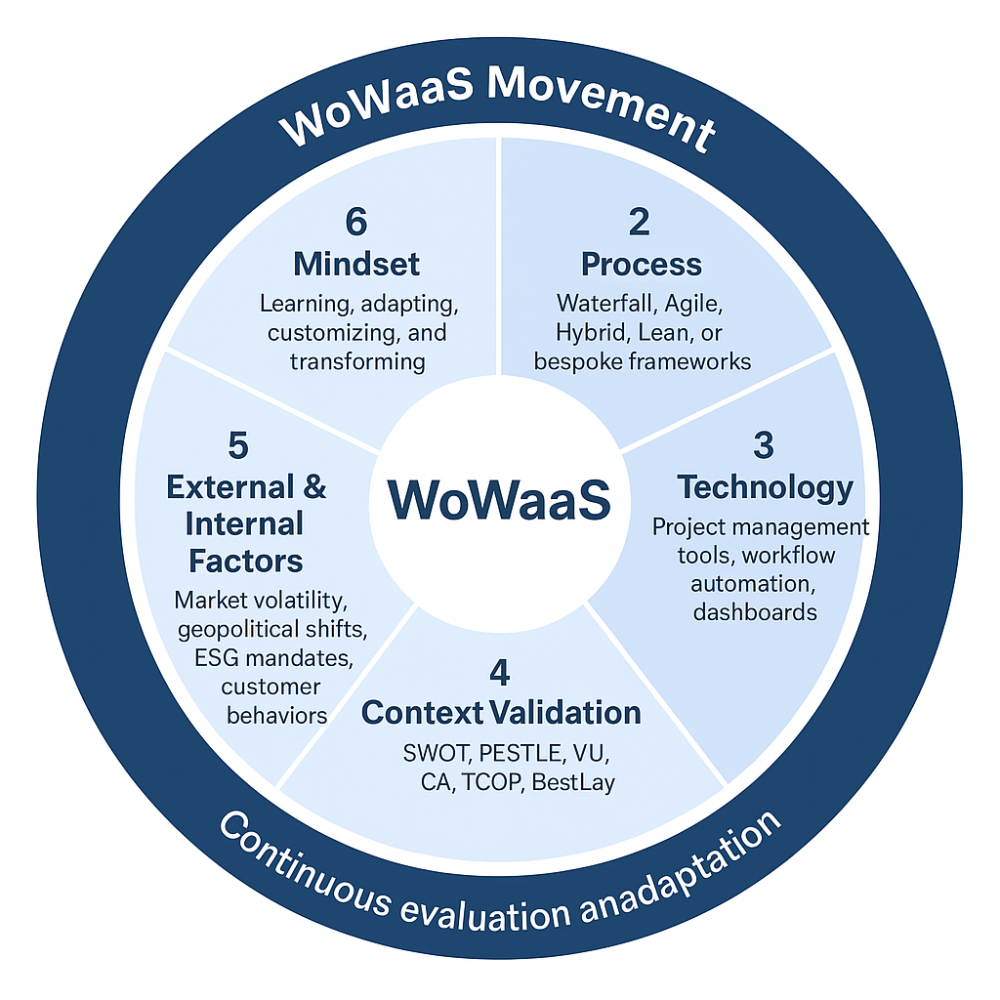
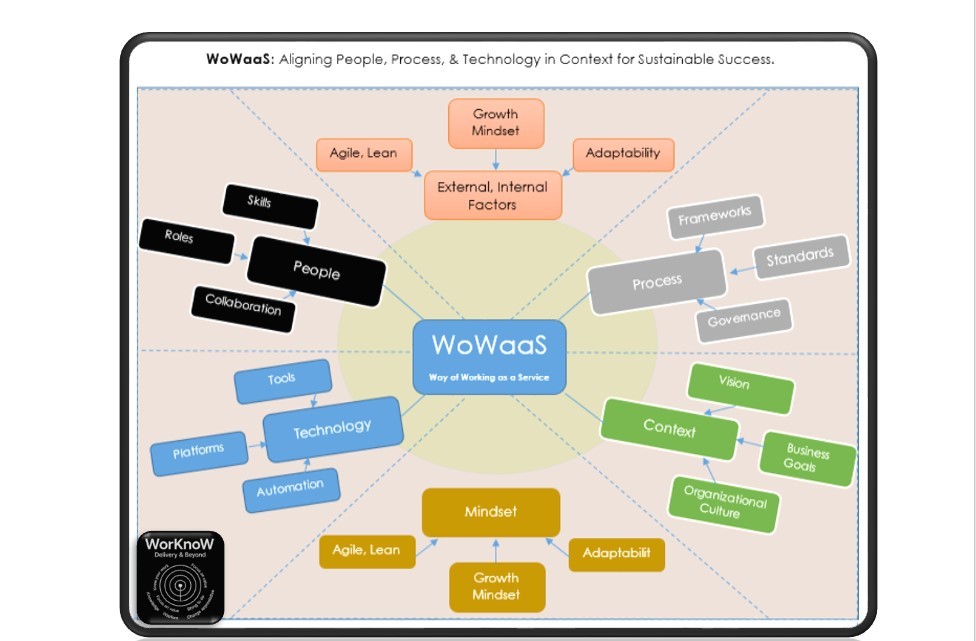
At its core, Ways of Working as a Service (WoWaaS) is built on six interdependent pillars — supported by a boundary layer of continuous recalibration.


                        WoWaaS : Circular Framework Visual

🔹1. People

  • Skills, roles, and leadership styles.
  • Cultural adaptability and readiness to change.
  • The human fabric that underpins delivery maturity.

🔹 2. Process

  • Waterfall, Agile, Hybrid, Lean, or bespoke frameworks.
  • PMO templates, governance standards, compliance.
  • Balancing predictability with flexibility.

🔹 3. Technology

  • Project management tools, workflow automation, dashboards.
  • Predictive analytics, value-stream mapping.
  • Generative AI models that recommend methodology shifts in real time.

🔹 4. Context Validation

  • Application of analytical lenses (SWOT, PESTLE, VUCA, TCOP, BestLay).
  • Regional and product-specific constraints.
  • Continuous recalibration to ensure alignment with shifting environments.

🔹 5. External & Internal Factors

  • Market volatility, geopolitical shifts, ESG mandates, customer behaviors.
  • Internal hierarchies, silos, budgets, commitments.
  • Recognizing that delivery does not happen in a vacuum.

🔹 6. Mindset (The Foundation)

  • Just as Agile is not a process but a mindset, WoWaaS is not merely structural.
  • It emphasizes learning, adapting, customizing, and transforming.
  • Stability lies not in avoiding disruption but in building resilience to it.


                        WoWaaS Circular Framework


🌍 The Boundary Layer: Continuous Recalibration

Around all six components lies the outer shell — a boundary of evaluation and adaptation.

  • This is where feedback loops, data-driven insights, and real-time adjustments happen.
  • It ensures WoWaaS is not a one-time setup but a living system.
  • This “boundary layer” makes WoWaaS dynamic: able to respond to wars, market shifts, technology disruptions, or sudden changes in organizational structure.

Why this matters

Without the boundary layer, organizations fall back into static adoption of frameworks — copy-pasting models that worked for others. With WoWaaS, they gain a resilient engine that:

  • Continuously senses context,
  • Adapts methods, and
  • Engineers' delivery mindsets fit for their own reality.

This is the “gravity” of WoWaaS: not just six pillars, but an ecosystem wrapped in continuous evolution.


🌍 Benefits of WoWaaS: Why It Matters Everywhere

WoWaaS is not just for projects. It is for every team, every leader, every process, every organization, every product, and every service in the world.

It gives you the one thing no framework alone can guarantee: adaptability on demand.

Benefits of WoWaaS

The advantages of embedding WoWaaS as an organizational capability are manifold:

🚀 What WoWaaS unlocks for you:

1. Resilience in Chaos When markets crash, when AI rewrites industries, when politics shift overnight — WoWaaS equips your organization with delivery models that bend without breaking.

2. Speed without Confusion No more endless debates over Agile vs Waterfall vs Hybrid. With WoWaaS, methodologies adapt in days, not years, to the context of your work.

3. Fit-for-Purpose Outcomes Every initiative — whether a billion-dollar megaproject, a startup launch, or an operations upgrade — gets its own tailored way of working, aligned to its unique environment.

4. Scalability at Every Stage From startups to global corporations, WoWaaS grows with you. It scales across business units, geographies, and industries — without diluting its impact.

5. PMOs that Transform into Engines PMOs stop being “governance cops” and evolve into Value Delivery Offices — offering adaptive catalogs of WoWaaS models to every internal customer.

6. Market Advantage That Lasts Organizations with adaptive WoW consistently deliver faster, cheaper, and with higher stakeholder satisfaction. They don’t just survive disruption — they shape it.


⚠️ Challenges Without WoWaaS: The Reality Check

Without WoWaaS, organizations fall back into the traps that have haunted decades of delivery:

  • Methodology Wars → wasted cycles debating “the right way.”
  • Rigid Templates → governance that suffocates adaptability.
  • Change Resistance → teams disengage when methods don’t fit their context.
  • Confidentiality Risks → external advice often clashes with internal security.
  • Siloed Knowledge → industries repeat mistakes instead of learning across domains.

🧩 Why This Is Bigger Than Projects

This is not about Agile vs Waterfall. It is not even just about project management.

WoWaaS is about how humanity organizes itself to get work done — in hospitals, in factories, in banks, in classrooms, in tech labs, in oil rigs, in government programs.

It’s the formula that lets us engineer delivery mindsets, no matter the complexity of the context.

👉 That is why WoWaaS is not just a benefit — it is a necessity.


What Could Have Been Saved with WoWaaS?

Let’s take a quick look at some global cases where WoWaaS (Ways of Working as a Service), if applied, could have prevented massive losses in time, money, and organizational trust.

(Note: These cases are referenced from public articles and industry reports. They are used here only for intellectual discussion and not as official validations. We invite the concerned organizations to review, validate, and share due diligence.)


🚆 HS2 Rail Project, UK

  • The project faced major cost overruns and continuous delays, raising questions about governance and adaptability. A WoWaaS model could have introduced adaptive governance—allowing certain delivery streams to adopt Agile approaches while keeping regulatory streams under strict compliance. This balance might have reduced financial bleed while ensuring accountability.
  • Challenge: The project has been plagued with multi-year delays and a cost blowout exceeding £40 billion (as reported in public domain). Rigid delivery models failed to adjust to evolving environmental, compliance, and stakeholder expectations.

How WoWaaS Could Have Helped:

  • People & Mindset: WoWaaS emphasizes cultural readiness assessments before scaling. This consultative lens could have prevented premature enterprise-wide rollouts.
  • Process & Technology: A federated governance model would allow different business units to adapt frameworks that respect their context (retail vs. corporate vs. compliance).
  • Potential Savings: Avoiding even one failed Agile rollout (~$200M write-off) could have been possible by validating readiness, tailoring practices, and monitoring change adoption under WoWaaS.

🛢️ Oil & Gas Megaprojects

  • Challenge: According to McKinsey research, more than 64% of megaprojects experience cost overruns. Many of these issues stem from rigid processes applied uniformly across all streams.

How WoWaaS Could Have Helped:

  • WoWaaS could have introduced dual operating modes—compliance-heavy processes for safety/environmental aspects and agile experimentation for operational efficiencies—reducing cycle time and wasted costs.
  • Technology & Process: A WoWaaS-enabled portfolio view would have allowed separation of compliance-heavy activities (e.g., safety & regulation) from operationally agile streams (engineering, procurement, construction sequencing).
  • People & Context: With integrated risk visibility dashboards, leaders could have made earlier go/no-go decisions and reduced rework.
  • Potential Savings: Even applying WoWaaS to avoid 15% schedule slippage in a $10B project equates to $1.5B in avoided delays.

🏦 Banking Sector – Digital Transformation

  • Challenge: Many global banks have stumbled in large-scale Agile transformations. The root cause? Cultural misalignment and leadership disconnect, not tooling. Failed programs often cost hundreds of millions in wasted effort and sunk investments.

How WoWaaS Could Have Helped:

  • People & Mindset: WoWaaS emphasizes cultural readiness assessments before scaling. This consultative lens could have prevented premature enterprise-wide rollouts.
  • Process & Technology: A federated governance model would allow different business units to adapt frameworks that respect their context (retail vs. corporate vs. compliance).
  • Potential Savings: Avoiding even one failed Agile rollout (~$200M write-off) could have been possible by validating readiness, tailoring practices, and monitoring change adoption under WoWaaS.

🛰️ NASA’s James Webb Space Telescope (JWST)

Initially estimated at $1 billion, JWST ended up costing over $10 billion with multiple launch delays. While scientific complexity was inevitable, WoWaaS could have ensured progressive elaboration and risk-managed governance across phases. Agile governance of supplier streams, balanced with compliance-heavy streams like safety and launch protocols, could have reduced wasted rework and timeline slippage.


🏥 Healthcare.gov Launch, USA

The Healthcare.gov website (2013) was a classic failure of rushed execution and lack of integrated governance. Despite heavy investment, it launched with massive technical issues, requiring urgent firefighting. With WoWaaS, a blended governance model could have validated readiness at each milestone, applied agile pilot testing, and ensured interoperability across vendors—saving both cost and public embarrassment.


🏗️ Berlin Brandenburg Airport (BER), Germany

The airport project became infamous for budget overruns exceeding €7 billion and delays of nearly a decade. Much of the chaos stemmed from misaligned contractors, lack of governance, and reactive decision-making. A WoWaaS-driven framework could have applied structured governance with adaptable delivery models, ensuring better contractor alignment, reducing rework, and maintaining public trust.


Summary Insight Across industries—be it infrastructure, oil & gas, finance, aerospace, healthcare, or public works—billions have been lost due to misaligned governance, rigid frameworks, or cultural unpreparedness. WoWaaS acts as a “Way of Working as a Service” safety net, ensuring the right governance for the right stream, balancing adaptability with compliance, and enabling cultural alignment for sustainable transformation.


✨ The Bigger Picture

Across industries, WoWaaS is not about replacing existing methods but about orchestrating the right Way of Working for the right stream — balancing compliance with agility, governance with adaptability, and people with processes. The potential savings? Billions of dollars, years of time, and invaluable stakeholder trust.Oil & Gas Megaprojects McKinsey research shows over 64% of megaprojects face cost overruns. WoWaaS could have helped separate compliance-heavy streams from operationally agile streams, reducing delays.


WoWaaS is the universal adapter for human work. Plug it in anywhere, and delivery becomes fit-for-purpose, resilient, and future-ready.

The Future Outlook: Where Should Organizations Begin?

For organizations reading this, the natural question is: Where do we start?

  • Step 1: Assess Maturity Understand your current ways of working. Are they rigid? Are they adaptable?
  • Step 2: Choose Engagement Decide whether WoWaaS is best implemented in-house, through partnerships, or via outsourced expertise.
  • Step 3: Pilot and Scale Start small. Pilot WoWaaS in a department or program. Measure adaptability, delivery speed, and stakeholder satisfaction. Scale gradually.
  • Step 4: Embrace the Mindset This is not about tools or assets. It is about cultivating a readiness to adapt, transform, and learn from internal and external environments.
  • Step 5: Future-Proof with AI and Data Leverage Generative AI and predictive analytics to enable real-time methodology tailoring.

Over the next 5–10 years, we may see WoWaaS emerge as a recognized service vertical, much like SaaS and PaaS. Organizations that adopt early will enjoy a decisive edge in navigating market uncertainty.


Conclusion

“Ways of Working as a Service” is not just a concept — it is an imperative. It acknowledges that in today’s world, no single methodology is sufficient. Delivery excellence comes from adaptability, context validation, and the courage to transform ways of working into a living service, not a static rulebook.

As we release this concept through WorkNow Edition 5, we invite leaders, practitioners, and PMO heads to reflect, challenge, and co-create. If WoWaaS resonates with you — explore it, test it, and help shape it. The future of delivery may well depend on it.


🌱 A Thought to Reflect On

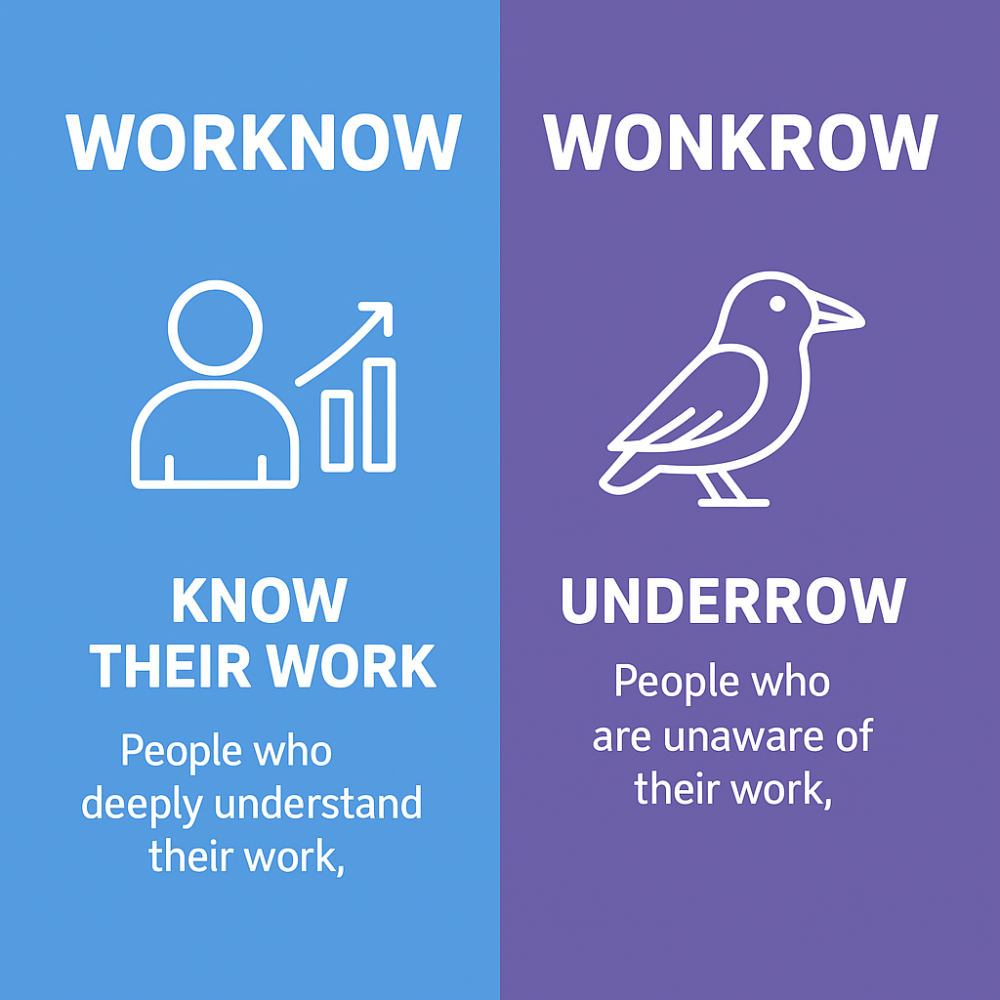
In our discussions, “WorKnoW” has emerged as a symbol for people who deeply understand their work—anchored in philosophy, structure, culture, ethics, and processes. They embody clarity and purpose.

By contrast, we introduce the idea of “Wonkrow”—a metaphor for those who operate without this awareness, often missing the alignment between work and meaning.

Both terms are not about labeling, but about reflection: Where do we stand today? Are we living as “WorKnoW” professionals, or drifting into the “Wonkrow” zone?


The path towards WorKnoW or away will lead with WonKroW


#Leadership #Mindset #WorkCulture #FutureOfWork #Innovation #AgileLeadership #GrowthMindset #Productivity #LinkedInCommunity #WorKnoW


About the Writer

PMO.Sagar Zilpe is a project leader, mentor, and thinker who blends real-world execution with deep curiosity about people, processes, and technology. With 140+ projects delivered, 16+ products designed, and patents to his name, he writes to spark reflection and action—bringing clarity to complex ideas with relatable stories and frameworks.